Product Understanding
The long-term brain of the product. Maintains the product constitution, tracks business rules and architectural decisions, and supplies context to every other agent.
The platform
A closed loop of specialized agents running over one SDK core — delivered into your CI, your cloud, or ours. Agent logic never forks per cloud or per git provider.
The wedge — live today
The long-term brain of the product. Maintains the product constitution, tracks business rules and architectural decisions, and supplies context to every other agent.
Predicts consequences before changes occur — dependency, API, service, database and customer impact — and generates a release risk score before merge.
Ensures failures permanently improve the system: root-cause discovery, links incidents to code and PRs, and updates constitutions and review policies.
Closes the loop from flagged risk to proposed safeguard — generates fixes, creates patch proposals, and submits them through a human approval workflow.
Turns a plain-language feature request into a scoped specification and task breakdown, grounded in Product Understanding's repository context.
Implements an approved task file, self-checks its own diff through Change Impact Analysis, and opens a draft PR for human approval.
Operate & govern
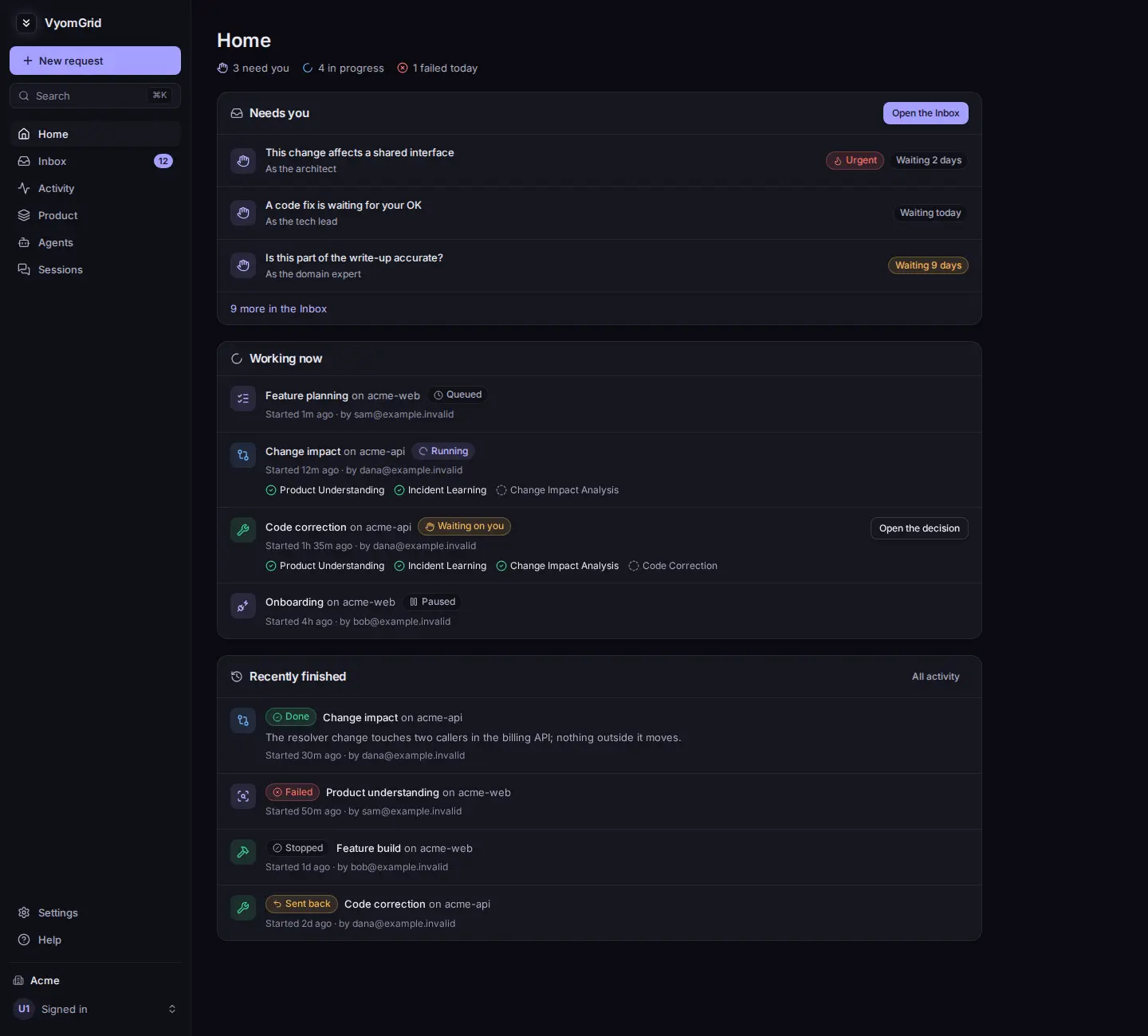
Orchestration, run history and evaluation across every deployment model. One standardized run record from every entry point — local CLI, customer CI, or vendor cloud — so observability never fragments.
A controlled collaboration layer: approvals, escalations, supervision, analytics and governance. Evidence informs a human's decision — it never closes one.
A tool-agnostic dashboard and approval layer across Claude Code, Cursor, GitHub Copilot and VyomGrid's own agents — unified run history, cross-tool inbox, uniform guardrails. Shared, not private: one inbox the whole org works from, with substitute approvers and per-persona routing.
The graph layer
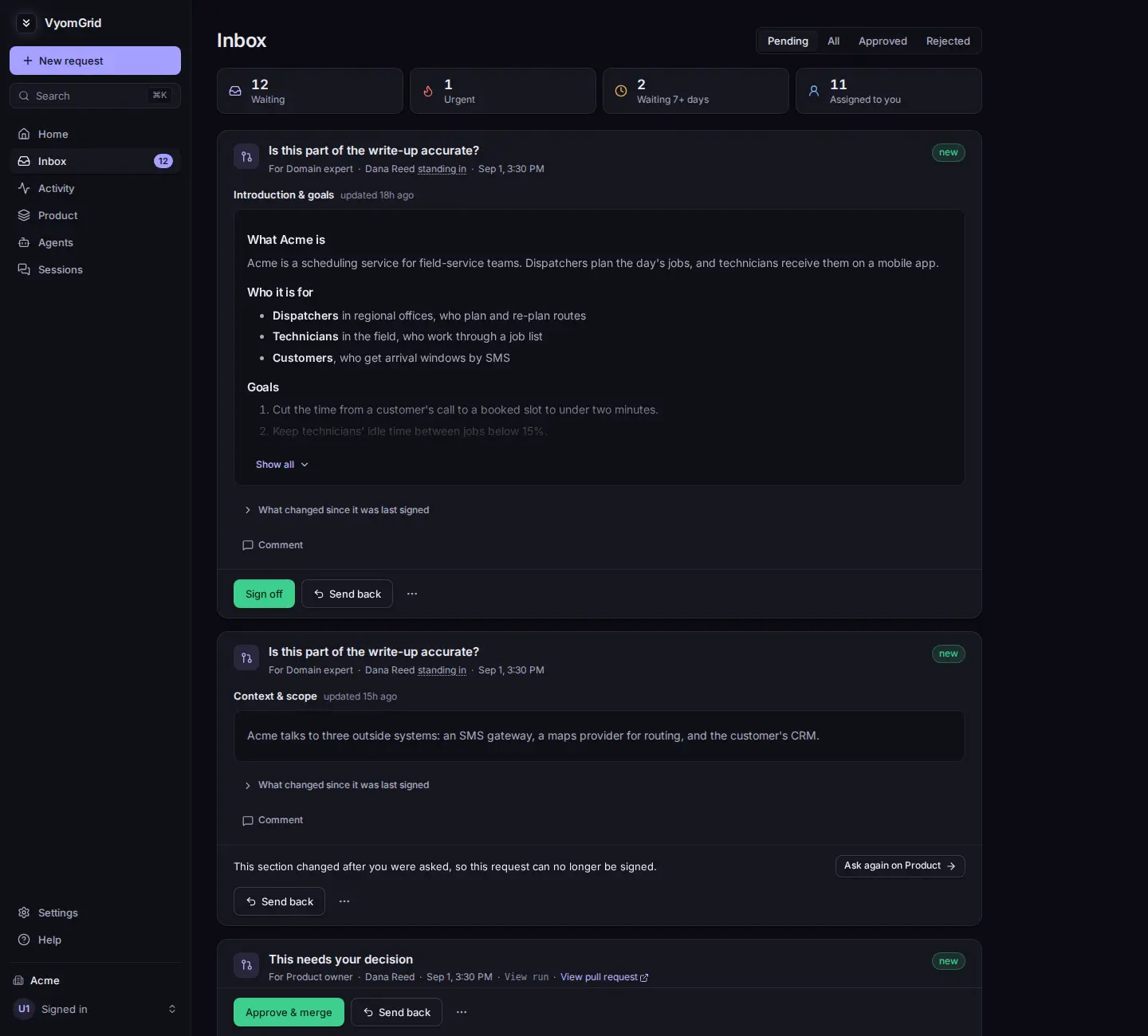
Every ratification — and its staleness — is shared state the whole team works from, not a private inbox.
When an upstream decision changes, every downstream ratification goes stale — still signed, but against something that no longer holds. Each comes back as a delta review, routed to the accountable persona. Surfaced, never auto-enforced.
Documents point at the code realizing them (block_realizations). "These files changed — which ratifications are now unverified?" becomes an answerable question, not archaeology.
A sign-off records the version it was signed against — and goes stale the moment that version moves. No forgotten approvals, no ritual re-reads.
What it looks like today
One shared inbox where ratifications land — and one command center over every agent run. Staleness is surfaced with the delta, never auto-enforced.
Delivery
Three deployment models, one shared pipeline. Agent logic never forks.
Agents run inside your CI — GitHub Actions, Azure DevOps, your Function App. Prompts and IP stay inspectable, inside your boundary.
Git provider webhook → our serverless endpoint on Azure, AWS or GCP. Closed-source, fully managed, zero infrastructure for you.
Your CI triggers, our platform computes. Customer trigger, vendor compute — the middle path for regulated teams.
Onboarding prepares the knowledge artifacts — codebase map, product constitution, CI workflow — in one command.